Fullerton's Median Price Hides a Contradiction: The Priciest Pocket Sells the Slowest
August 27, 2026
August 27, 2026
If a home in Fullerton is priced forty percent above the citywide median, how much faster should it sell? The obvious answer is faster. More desirable homes in tighter markets usually move quicker, not slower. But that is not what the transaction data in Fullerton shows, and the gap between the obvious answer and the real one tells you something the median price never will.
Across Fullerton as a whole, the three months ending June 2026 put the median sale price at roughly $1.0 million. As of July 2026, homes were averaging 35 days on market, up from 32 days the year before. Meanwhile, in Raymond Hills, one of the city's hillside neighborhoods, the median sale price over the past year has run closer to $1.4 million as of May 2026. That's a real premium. And Raymond Hills homes have taken an average of 44 days to sell as of that same May 2026 snapshot, longer than the citywide pace, not shorter.
A buyer comparing neighborhoods on price alone would call that a contradiction. It isn't. It's a clue about what's actually being sold.
Real estate math usually assumes a straight line: higher demand pushes prices up and shortens time on market at the same time, because more buyers are chasing fewer homes. Fullerton's own citywide figures mostly follow that line. As of July 2026, Redfin rated the Fullerton market a 77 out of 100 on its competitiveness scale, with homes typically fielding multiple offers and closing about 1 percent above list price. That's a seller's market by any conventional measure.
Raymond Hills breaks the pattern. It carries a higher median price than the rest of the city and a longer average time on market. If price and speed moved together the way the simple story predicts, that shouldn't happen. Something else is doing the work.
The something else shows up in a number most buyers never think to check: Walk Score, the public index that rates how many daily errands a resident can run on foot from a given address. Unlike a median price, a Walk Score doesn't shift month to month, it reflects the physical layout of a place. Fullerton as a whole carries an overall citywide Walk Score of 52, but that average erases enormous variation between its pockets. Downtown Fullerton scores 97. Sunny Hills scores 39. West Coyote Hills scores 21.
| Fullerton Area | Walk Score |
|---|---|
| Downtown Fullerton | 97 |
| Sunny Hills | 39 |
| West Coyote Hills | 21 |
| Citywide average | 52 |
Downtown's score means nearly every errand, from coffee to groceries to a dentist appointment, is a walk rather than a drive. West Coyote Hills, at the opposite end, is built for a car. Raymond Hills was not included in that same walkability comparison, but its physical layout, curving hillside streets with peaceful views and no retail woven into the blocks, puts it much closer to the West Coyote Hills pattern than the downtown one.
Here is the part that matters for a buyer sizing up neighborhoods: a high Walk Score correlates with a bigger, more interchangeable pool of buyers. Anyone who wants to walk to dinner is a candidate for a walkable home, and that pool turns over fast. A low Walk Score means the buyer pool narrows to people who specifically want space, privacy, or a view badly enough to accept a car-dependent daily routine. That's a smaller pool, and smaller pools take longer to clear even when the individual buyers in it are willing to pay more.
Fullerton's neighborhoods aren't competing on one scale of desirability. They're selling two different products under one median: convenience, which moves fast, and seclusion, which moves for more money but waits longer for the right buyer to show up.
Downtown Fullerton. This is the walkable core, and the Walk Score of 97 is not marketing language, it's a description of what a resident's week actually looks like. Errands, dinner, and a weekend coffee run happen without starting a car. That convenience is priced in, and it's also what keeps the buyer pool wide and turnover quick.
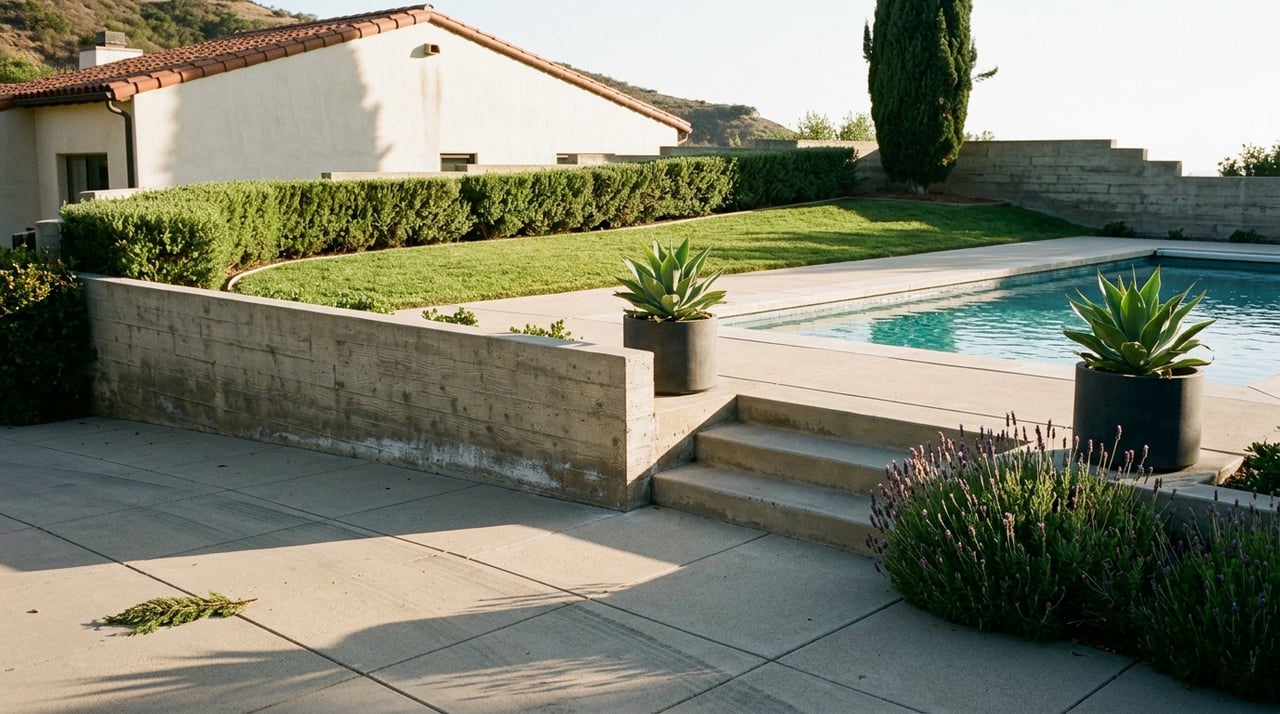
Raymond Hills. This is the hillside trade-off made visible. Homes here sit on rolling streets close enough to downtown to reach it easily, but the neighborhood itself isn't built around walkable retail. What residents get instead is space, quiet, and proximity to Hillcrest Park, along with dining at The Cellar and Rialto Cafe and a weekend habit of the Fullerton Farmers Market a short drive away. The $1.4 million median and the 44-day average time on market are two sides of the same fact: fewer buyers want exactly this trade, but the ones who do are willing to pay for it.
Amerige Heights. This one is the most interesting wrinkle in the data, because it was built to be walkable and mostly delivers on the promise, with a catch. The neighborhood grew up around Amerige Heights Town Center, a master-planned retail plaza anchored by Target and Albertsons, with a Barnes & Noble, Hoshi Sushi, and California Tofu Grill filling out the daily rotation. Residents consistently name walkability as one of the top reasons they like living there, and the tree-lined residential streets support that. But more than one longtime visitor to the town center itself has pointed out that the parking lot layout favors driving from store to store rather than strolling between them. The homes are walkable. The shopping plaza, despite the name, asks you to get back in the car between stops.
Sunny Hills and West Coyote Hills. These are Fullerton's clearest car-dependent suburban stock, with Walk Scores of 39 and 21 respectively. Lots tend to run larger here, which is its own kind of trade, more room on the property in exchange for less on foot. Buyers drawn to this end of the spectrum are usually optimizing for the same things Raymond Hills buyers are: space and quiet over proximity.
The practical takeaway isn't that walkable is better or that hillside is better. It's that the two are answering different questions, and mixing them up costs time on either side of a transaction.
Does a low Walk Score always mean a lower price? No. Raymond Hills is the clearest counterexample in Fullerton right now, with a submarket median well above the citywide figure despite limited walkability. Price and walkability are answering different buyer priorities, not moving on the same scale.
Which Fullerton neighborhood is selling fastest right now? The citywide average sat at 35 days on market as of July 2026, and neighborhoods with higher Walk Scores, like Downtown Fullerton, tend to draw from a wider buyer pool that can move a listing more quickly than that average suggests.
Is Amerige Heights actually walkable? For daily residential life, largely yes, based on how residents describe it. For the shopping plaza itself, less so. The town center was designed with walkable retail in mind, but the parking lot layout means most visitors drive between individual stores rather than walking the plaza end to end.
If you're comparing Fullerton neighborhoods and want to know what a specific street or price point actually means for your timeline, not just the citywide average, Merita Rama can walk you through it. Get a Free Home Valuation and start the conversation with numbers that match your neighborhood, not just the city's.
Stay up to date on the latest real estate trends.
Partner with a team that values integrity, precision, and exceptional service at every step.
MERITA RAMA | CA DRE# 01297882 | RCR ENTERPRISES, INC.
ADDRESS 13604 WHITTIER BLVD WHITTIER, CA 90605